"One ought, every day at least, to hear a little song, read a good poem, see a fine picture
and, if possible, speak a few reasonable words." ~Goethe

~ also, if possible, to dwell in "a house where all's accustomed, ceremonious." ~Yeats

Thursday, July 28, 2022

Great - Grandmother's Day Book

DAYS WHERE WE LIVE
ACCUSTOMED, CEREMONIOUS
"Sarah E. Lindsey
Niotaze, Kansas"

Days

What are days for?
Days are where we live.
They come, they wake us
Time and time over.
They are to be happy in:
Where can we live but days?

Ah, solving that question
Brings the priest and the doctor
In their long coats
Running over the fields.


Philip Larkin (1922 - 1985)

I recently discovered two miniature books (both about 3" x 4") amongst the papers of my Great - grandmother Sarah Elisabeth Hartman Lindsey: the 1920 date book above and the New England Primer below. The date book is blank up until the end of September.

"Gail called up from Kansas City
& wanted to know when I
was going up."

"First Frost
Country ~ Niotaze"

The next few entries, between 11 - 25 October, record Sarah's trip from Caney, Kansas, to Summersville, Missouri. A number of family members lived in Caney during the early 20th Century, but not until discovering this booklet did I know that Sarah's eldest son, Jim Lindsey (the brother of my Grandfather Paul, who was Sarah's youngest son) had ever lived in Summersville, 275 miles away.

Sarah keeps track of the weather (very rainy!) and the letters she has written to most of her other children: Paul (my grandpa!), Bea and Gail (who had already written to her); Wayne and Virginia (no letter for Mabel this time).

Nothing else for the rest of the year. However, on the the very back page, using the 1921 preview calendar, Sarah mentions returning to Peru (another small Kansas town, near Caney) from another trip to Summersville.

I wonder how Sarah made these long trips from Kansas to Missouri. Was it by train? Or by car? Years before, this woman had made her way out to Nebraska and back again, giving birth to my grandfather in a covered wagon; so she was no stranger to traveling around the wilderness!

When I need some perspective on my recent move from Indiana to Virginia, I think of Sarah's journey, in the 1880s, from Ohio to Indiana to Illinois to Nebraska, starting over each time, teaching school in each location. She lived on a homestead in a two - room house, enduring hardship, drought, near - starvation, the birth of nine children, the loss of a four - year - old daughter (before my grand-dad was born) to a horse fall accident, and their eventual relocation from Nebraska to Kansas. Sarah gave birth to my grandfather on this return trip in 1895, attended by her own father, who was a medical doctor of some kind and traveled with them.

Why did she do it all? For love, for adventure, for a better life -- and for me, her great - grand-daughter to have the opportunity, a century later, to move all around the country at will and without complaint! So I shall try to embrace that blessing and live up to her legacy, and -- of course! -- teach the whole story to my own granchildren -- Sarah's great - great - greats!

"Reached Peru, Kansas
From Summersville, Missouri
February 15, 1921"

In addition to Sarah's personal notations, the pre-printed note that concludes the date book is also of interest, particularly the phrase: "existing conditions this year.” Sounds like an early version of the supply chain issues with which we have all grown so familiar in the past couple of years! Could it be that Sarah got this booklet -- courtesy of Ritter Dental Mfg. Co. -- free from her dentist? Or was someone in the family practicing dentistry without a license? Perhaps not likely — but not impossible!

Best of all, on a page for telephone numbers, just before the maps section, Sarah has jotted down a recipe for oatmeal cookies:

******************

Near the back of the miniature New England Primer, Sarah has pinned in the obituary of her sister-in-law Anna (1852 — 1888). Anna was a younger sister of Sarah's husband (my great - grandfather) James Sankey Lindsey (1846 - 1921). How sad it is to read of her life cut so short by an illness that today may well have been successfully treated with antibiotics. Did Anna use this quaint little booklet for teaching her young students?

******************

Next Fortnightly Post
Sunday, August 14th

Between now and then, read
THE QUOTIDIAN KIT
my shorter, almost daily blog posts
www.dailykitticarriker.blogspot.com

Looking for a good book? Try
KITTI'S LIST
my running list of recent reading
www.kittislist.blogsppot.com

Thursday, July 14, 2022

Hail Marie!

THE GUILLOTINE
ACCUSTOMED, CEREMONIOUS, GRUESOME
Guillotine Pendant Necklace

1.
"The theme of death and reversibility reappears in the ambivalent status of toys like the little guillotines that were sold in France during the time of the Revolution. In 1793 Goethe wrote to his mother in Frankfurt requesting that she buy a toy guillotine for his son, August. This was a request she refused, saying that the toy's maker should be put in stocks."


~ Susan Stewart
~ from On Longing: Narratives of the Miniature,
the Gigantic, the Souvenir, the Collection


2.
Marie Antoinette

Only fourteen, sent from Austria
Destined to be queen
When I married Louis, the Dauphin of France
Wonder if I’d stand a chance
Blonde and pretty, but no intimacy
Inability to do my duty – to produce an heir
Ridicule, I’ve had my share
And you know the rumors fly
“Madame Deficit!” “She’s such a cruel spendthrift!”
They don’t know me
I am just Marie

“Look at the Dauphine, she’s such a silly teen”
“She’s gambling all the Treasury!”
Is pleasure such a crime?
The finer things in life were always mine
Decadent, it’s true, but in my heart I’m blue
It fills me, this empty Marie

Shunned the nobility, all that ceremony
Built my rustic retreat at Petit Trianon
Just my friends and me
Losing popularity
Where did we go so wrong?
Louis wasn’t strong
Helping the colonies
And then our country suffered tragedy
Starvation and poverty
And I lost my baby, why?
In ’89 they stormed into Versailles and made me face them
On the balcony
End of monarchy, taken to Tuileries
To the border we would try to flee
Caught in the Varennes Flight
Discovered that my hair was shocked to white
Conciergerie, Prisoner 280
I’m only Citizen Marie

Louis tried, condemned
I knew this was the end
The Terror
Everyone against me
My son testified
They forced him to say lies
Found guilty for depravity
To mothers I do plea
much can you take away from me?
So to the guillotine I’ll ride with dignity
I’m your Queen
I am still Marie


~ by Lady Gaga

3.
And lastly, a few words to the wise from poet Jim Barnes:

"Bastille Day in France is a big joke, but they don't tell many that it is: the prisoners behind bars on that day were countable in single digits. The salute by the slipstreams (blue, white, red) of the low and roaring jets make it fun, though. Wish I could be there to pretend something really important happened that day.

"Be sure to say your Hail Maries, just in case!
"

Marie Antoinette [1755-1793] in a Muslin Dress, 1783
by Élisabeth Louise Vigée Le Brun (1755 - 1842)


Click to read more Bastille Day poems

Additional Bastille & Independence Day Posts
from previous years:

Bastille Day: Is There A World You Long To See?
Two Poems for Bastille Day
Eagles is Freedom
Carriker Barrel
Viva la Revolution
Hail Marie!

No More Forever
Andrea Dworkin
Liberté, égalité, fraternité!
If I Had a Hammer
Happy Bat - stille Day!

Indpendence Day 2009
Resident Alien
Red, White & Blue Pie
Who Needs Fireworks?!
May God Bless and Keep the Upstart Americans
Loving America the Al Franken Way
American Tune
Practice Pysanky, Practice Resurrection, Practice Revolution
I Pledge Allegiance

******************

Next Fortnightly Post
Thursday, July 28th

Between now and then, read
THE QUOTIDIAN KIT
my shorter, almost daily blog posts
www.dailykitticarriker.blogspot.com

Looking for a good book? Try
KITTI'S LIST
my running list of recent reading
www.kittislist.blogsppot.com

Tuesday, June 28, 2022

Faded Autographs

A LATE 19th CENTURY AUTOGRAPH ALBUM
FILLED WITH SENTIMENTS,
ACCUSTOMED, CEREMONIOUS
The Autograph Book of my great - grandmother
Sarah Elisabeth Hartman Lindsey (1856 - 1937),
filled in as she traveled west in 1886 - 1894,
from Indiana to Illinois to Nebraska

The book is embellished with drawings and quotations from
Evangeline: A Tale of Acadie
by Henry Wadsworth Longfellow (1807-1882)
Fair was she to behold, that maiden of seventeen summers.
Black were her eyes as the berry
that grows on the thorn by the wayside,
Black, yet how softly they gleamed
beneath the brown shade of her tresses!
Somewhat apart from the village,
and nearer the Basin of Minas,
Benedict Bellefontaine,
the wealthiest farmer of Grand-Pré,
Dwelt on his goodly acres:
and with him, directing his household,
Gentle Evangeline lived . . .
Oft on autumnal eves, when without
in the gathering darkness
Bursting with light seemed the smithy,
through every cranny and crevice . . .
Bright rose the sun next day;
and all the flowers of the garden
Bathed his shining feet with their tears,
and anointed his tresses
With the delicious balm that they bore
in their vases of crystal.
Filled was the air with a dreamy and magical light;
and the landscape
Lay as if new-created in all the freshness of childhood.
Peace seemed to reign upon earth . . .


The book contains two dozen or so autographs.
Here are a couple of my favorites:


I don't know who Lillie Ely was to Sarah,
but I love what she wrote:

"In memory's basket
drop one pearl for me
."

On the other hand, this signature I know well!
It is that of my great-grandfather,
Sarah's husband, James Sankey Lindsey.
In the happier times, it was his way
to call her "Sallie" and hers to call him "Jimmie."

"Sallie
It seems so strange and it
makes me laugh to think that
you want MY authograph

Jas. S Lindsey
Sheldon, Ill
July 2, 1886

Reading these, and so many other, quaint inscriptions, I could hear a soundtrack of golden oldies from my own coming of age: autographs, photographs, memories, traces. Though Sarah herself would have never heard these nostalgic tunes, she surely had other evocative melodies floating through her memory as she perused the treasured messages in this keepsake album that she saved all of her life and passed down to my mother.
Photographs and Memories
[1974]

Photographs and memories
Christmas cards you sent to me
All that I have are these
To remember you

Memories that come at night
Take me to another time
Back to a happier day
When I called you mine

But we sure had a good time
When we started way back when
Morning walks and bedroom talks
Oh how I loved you then

Summer skies and lullabies
Nights we couldn't say good-bye
And of all of the things that we knew
Not a dream survived

Photographs and memories
All the love you gave to me
Somehow it just can't be true
That's all I've left of you

But we sure had a good time
When we started way back when
Morning walks and bedroom talks
Oh how I loved you then


Music & lyrics by Jim Croce (1943 – 1973)

Traces
[1969]

Faded photographs, covered now with lines and creases
Tickets torn in half, memories in bits and pieces
Traces of love, long ago that didn't work out right
Traces of love

Ribbons from her hair, souvenirs of days together
(Things we used to share, souvenirs of days together)
The ring she used to wear, pages from an old love letter
Traces of love, long ago that didn't work out right
Traces of love, with me tonight

I close my eyes and say a prayer
That in her heart, she'll find a trace of love still there
Somewhere

Traces of hope in the night that she'll come back and dry
These traces of tears from my eyes


Music & lyrics by Buddy Buie, J. R. Cobb, Emory Gordy Jr. Performed by Classics IV
*****************

Thanks to my cousin Cindy,
who helps me keep track of
everything we know about Sarah today,
including her papers, photographs, and artifacts.

Here we are: Cindy & Kitti, second cousins, once removed.
Sarah's great - great- granddaughter & great - granddaughter:
Portrait of Sarah, along with snapshot of Kitti & Cindy
And it is surely astounding to reflect that not once in the three billion years since life began has your personal line of descent been broken. For you to be here now, every one of your ancestors had to successfully pass on its genetic material to a new generation before being snuffed out or otherwise sidetracked from the procreative process. That's quite a chain of success.”

from The Body: A Guide for Occupants (p 7)

*****************

Consider the fact that for 3.8 billion years, a period of time older than the Earth's mountains and rivers and oceans, every one of your forebears on both sides has been attractive enough to find a mate, healthy enough to reproduce, and sufficiently blessed by fate and circumstances to live long enough to do so. Not one of your pertinent ancestors was squashed, devoured, drowned, starved, stranded, stuck fast, untimely wounded, or otherwise deflected from its life's quest of delivering a tiny charge of genetic material to the right partner at the right moment in order to perpetuate the only possible sequence of hereditary combinations that could result -- eventually, astoundingly, and all too briefly -- in you.”

from A Short History of Nearly Everything

both by Bill Bryson
Next Fortnightly Post
Thursday, July 14th

Between now and then, read
THE QUOTIDIAN KIT
my shorter, almost daily blog posts
www.dailykitticarriker.blogspot.com

Looking for a good book? Try
KITTI'S LIST
my running list of recent reading
www.kittislist.blogsppot.com

Tuesday, June 14, 2022

Houses I Love Driving Past

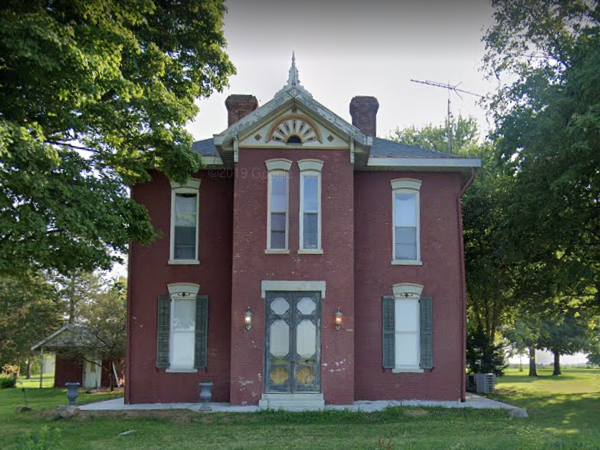
A HOUSE WHERE ALL'S ACCUSTOMED, CEREMONIOUS
THIS ONE ~ IN MISSOURI
This house has obviously been standing since way before 1967
when I first moved to St. Charles. For a good ten years, we
must have driven by it countless times, yet somehow it escaped
my notice until only recently -- perhaps due to the ever-changing
paths of new service roads and reduced greenery along the highway.
"Howard lay flat on the carpet and closed his eyes to allow himself one of his secret pleasures: picturing the house as it had looked four years ago on the fall afternoon when he and Mirella first saw it, reliving his curious shock of recognition, as if he had found not the house he'd always wanted, but the house he'd always missed. . . .

"And, in its way, it was perfect. A 1754 white colonial with dark red shutters the color of hemoglobin, spare yet consequential, built by a wealthy housewright for himself, still possessing its original floorboards and a few original windowpanes. . . .

"Howard recalled that moment with absolute clarity: the three greenish panes of bull's-eye glass gleaming above the front door; the thick, elephant hide of the old painted clapboards . . . A kind of rapture had flared within him, bringing with it a profound sense of well-being that was almost like exhaustion.
". . . the house, [was] beautiful and meaningful in its age and resilience and in the purity of its simple lines. . . . for years he'd dreamed of living on the coast, in the oldest colonial house in the oldest town he could find. He loved colonial houses; he loved them because they were symmetrical and unpretentious and because they seemed designed not only to withstand the elements, but to improve with assault. They had a plain, stringent elegance that he instinctively clung to, for reasons he still did not altogether understand beyond the reflexive ones." (19 - 21)

"It was a beautiful drawing. Even Howard, preoccupied with getting the drawing straight on the overhead projector, could see how elegant and austere and perfectly proportioned this house would be. He pointed out the simple cornice and the classic architrave; he pointed out the two long sidelights beside the door, each shaped like a traditional pilaster. 'Because,' he said, embarrassed by his own enthusiasm, 'a front door should be a contemplative object, a moment of projecting outward or inward, not a means for shutting everything out.'"
(249)

from A Perfect Arrangement
by Suzanne Berne
[see also Longly, Nanny, 2003, Complications]
THIS ONE ~ IN INDIANA
Many times between 1985 - 87, when riding the airport express bus from
Notre Dame to O'Hare Airport, I awaited the moment when we sped past
this admirable house, giving me a few seconds to wonder about its history.

And these two

~ ABOVE & BELOW ~

that I never fail to admire on the drive
between Lafayette and Indianapolis
P.S.
See the similarities?

**************

Next Fortnightly Post
Tuesday, June 28th

Between now and then, read
THE QUOTIDIAN KIT
my shorter, almost daily blog posts
www.dailykitticarriker.blogspot.com

Looking for a good book? Try
KITTI'S LIST
my running list of recent reading
www.kittislist.blogsppot.com

Saturday, May 28, 2022

The Conscious Being of the House

A HOUSE WHERE ALL'S ACCUSTOMED, CEREMONIOUS
"The house was quiet . . .
part of the meaning, part of the mind . . .
"

The House Was Quiet and The World Was Calm

The house was quiet and the world was calm.
The reader became the book; and summer night

Was like the conscious being of the book.
The house was quiet and the world was calm.

The words were spoken as if there was no book,
Except that the reader leaned above the page,

Wanted to lean, wanted much most to be
The scholar to whom his book is true, to whom

The summer night is like a perfection of thought.
The house was quiet because it had to be.

The quiet was part of the meaning, part of the mind:
The access of perfection to the page.

And the world was calm. The truth in a calm world,
In which there is no other meaning, itself

Is calm, itself is summer and night, itself
Is the reader leaning late and reading there.


by Wallace Stevens (1879 - 1955)

********************

More memories
of 443 as shared by a previous resident,
Robert W. Topping (1925 - 2009)
Young Bob Topping
on Tricycle & Bicycle
Click to see more photos from the Topping Era

Please enjoy Bob's childhood recollecions,
interspersed with a few current - day photographs:

"The kitchen was a nightmare for a kitchen designer. It had two huge windows and the remnant of a chimney on the south wall; two doors,an exit and a door to the rather generous pantry on the west wall; a door to the dining room and one to the living room on the north wall (not to mention the north wall had an offset); and the east wall had doors to the basement and a back stairway to the second floor. All of those obstacles left barely enough room for a kitchen cabinet, a sink, a refigerator, and agas range, though somehow Mother seemed to make it all work. She produced a lot of goodies in it, as did my sisters, and sometimes even my father. He could produce a tasty meatloaf with a half pound of hamburger, a week's supply of lefovers from the refrigerator, and a couple of cups of stale bread crumbs from the bread drawers. I recall one meatloaf he made with leftovers that included leftover meatloaf. Haha!


"Upstairs, off the main hall, were three bedrooms: the south room occupied by my sisters, the north "study," occupied by each of us five brothers at various times, and the east room of my parents. Off the east room was a smaller room, called an alcove, which included two sizeable clothes closets and a dormer window as well as a white iron crib. It was the room which served a nursery for all four of mother's children. It was "my room" until I was about four or five. I had my "stuff" in a lower drawer in one of my parents' high - boy chiffoniers.

"The bathroom had two small walk - in closets, a clawfoot bathtub, and a large sink surrounded by a marble top and splashback, and also a dormer window, giving any occupant of the toilet a fairly grandiose western sweep of our backyard, garage, and Littleton Street beyond.

"The third floor -- we called it the attic -- was wide open until Daddy built two larger dormer style rooms with beds in each. That is where my brother Dale and I slept when we got older. In the Depression years, my folks took in students from time to time, and they lived on the third floor. They helped my mother with housework or did chores in the yard for room and board. I remember only two of those students, Louis and Ezra, the latter a French horn player in the Purdue marching band. My father may have been partial to horn players; both he and Grandpa Topping had played baritone horn in the Kanawaka Township Band back in the 1880s.


"The garage, by the way, was built by my father from the lumber he salvaged when he dismantled the barn that sat at the rear of our rather generous yard. I never saw the barn; it was torn down long before I was born, but it was not unlike others that still existed on our neighbors' properties when I was a tyke running about the neighborhood. Remember -- barns were the garages of the nineteenth century; horses were the principal means of transportation and barns supplied not only their housing but a place to store buggies, tack, and horse "fuel": hay and oats.
*********************

One of the Topping boys
in front of the new garage
that Dad built

A view of the garage in foreground (looking east to west)
with the northbound neighbor's barn in the background
[frosty garage windows & fenceposts]

A panoramic view (left to right) of:
1. neighboring garage to the south
2. 443 plus big barn with hayloft
3. additional outbuildings to the north

"My father and mother were foragers; both had been farm kids when the pursuit of foodstuff was a daily, mainstream activity. Even the squirrels which abounded in our neighborhood, buried walnuts all over our yard. The yard was dotted with fruit trees my father planted: Montmorency cherry; several varieties of apple; pear, peach, even an apricot tree. The vegetable garden area which replaced the barn included a strawberry patch, a lengthy row of rhubarb, blackberry bushes, and even a gooseberry bush which today is probably an endangered if not extinct species. If you ask someone if they've ever eaten gooseberry pie, and they reply (with relish) that they have, you know they must have been born before 1932.

Topping Garage, Back of House, New Garage built in 2005

"Along the north line next to the neighbor's rapidly deteriorating barn was Father's pride and joy: A Concord grape arbor which produced neither wine -- heaven forbid! -- nor even canned grape juice, but case after case of twenty-four glass jars each of the finest, clearest grape jelly that my mother could produce or that I have ever tasted.

"The jars of grape jelly were stored in our "fruit cellar" together with mother's pickle relish and canned peaches plus a seemingly endless supply of mincemeat which she and Daddy produced every fall from the ripened apples of a half dozen trees. There were also Ball Mason quarts of pie cherries picked from four or five trees by us kids. I remember it as one of the first family chores I engaged in."


Mincemeat!
A tradition we have carried on during our years at 443
-- except that ours is made from homegrown green tomatoes!
Additional House Posts
Talented Residents
Renovations
Christmas Fencepost
Vintage Fenceposts
Property Line

Next Fortnightly Post
Tuesday, June 14th

Between now and then, read
THE QUOTIDIAN KIT ~ 443 Photos: "Historic" & "Current"
my shorter, almost daily blog posts
www.dailykitticarriker.blogspot.com

Looking for a good book? Try
KITTI'S LIST
my running list of recent reading
www.kittislist.blogsppot.com

Saturday, May 14, 2022

Over a Hundred Years of Living

A HOUSE WHERE ALL'S ACCUSTOMED, CEREMONIOUS
"What have you seen in your hundred years?"
[Additional Contemporary Photos]

Memories of 443 as shared by a previous resident,
Robert W. Topping (1925 - 2009)

"The house at 443 Robinson Street needed both repair and paint when my parents and their three sons (aged 13, 7, and 4) moved into it in 1911. Grandpa Topping and Dad's wealthy Long Island aunts loaned him the money to buy the place -- the only residence Mother and Dad ever owned and my only childhood home.

Young Bob Topping on Robinson Street
Click to see more photos from the Topping Era

"Robinson Street was the main north - south thoroughfare on the extreme east side of West Lafayette, or at least east of Salisbury Street. It curved northwesterly up grade from the North River road, probably an original cow path traversing the clay - and - gravel bluffs along the west bank of the Wabash River meandering generally west and south as the natural division between Lafayette and West Lafayette.

"Our property comprised about three - fourths acre and lay about thirty to forty feet (I judge) above the Wabash flood plain and overlooked the river and most of Lafayette, especially a nondescrpt industrial building that sat like a dirty loaf of bread nearly along the river's edge with high, easily read letters that spelled "Lafayette Ice & Coal Company" on its west wall. Later, after the end of Prohibition, the sign was repainted a tawdry yellow with huge red letters trimmed in black that read "Home of YE TAVERN BREW." It advertised the local brewery that beer drinkers joked about. . . . Dad hated the sign and complained between clenched teeth that his view of the Wabash Valey and Lafayette was obstructed by the largest, ugliest monster ever . . .

"Built in 1896, probably by a retired Tippecanoe farmer, our house was a three - story, massive - looking, white clapboard edifice classed as Queen Anne style architecture. From its outside, you saw a long sloping roof up to a ridge pole and on the northeast corner, a three - sided cupola and a red - brick chimney that vented a handsome Italian marble tile parlor fireplace that Dad and Mother never used. "Could burn the place down," Dad would say. Built on a high foundation with a rather shallow, brick - floor basement, the house also had a broad front porch; and since the lot sloped from rear to front, one had to climb seven wood steps to the porch and front door but only two at the screened back porch. There was also a north porch entry to the living room.

"Inside, the house boasted the aforesaid parlor, a front hall and a two - landing oak banistered, open stairway to the second floor, a living room,and a dining room. The front hall was impressive, its main feature the polished banister that frequently warmed the seats of the pants of all five Topping male offspring who believed its purpose was for sliding. But most impressive were the front hall bookcases. Three rows of glass fronts displayed the complete works of Mark Twain and most of those of Charles Dickens, several volumes of Victor Hugo, and Shakepeare, and one high book case that contained volume after volume of the Proceedings of the American Institute of Electrical Engineers. A halltree (we called it) held hooks for coats and hats and the seat was a lid beneath which we kept an assortment of knit hats, scarves, and gloves for winter. The odor of mothballs in it could knock you over. A smaller closet under the second stairway landing held more coats plus the family vacuum cleaner. . . . "


A few alterations, but you can see it just as Bob describes!

I want to share more of Bob's Robinson Street reminiscences, but for right now, I must stop to insert this poem whose opening stanza connects perfectly with the image of the Topping brothers sliding down the banister (or, as poet Linda Pastan writes:
" . . . the lovely children of earth
who run up and down the stairs so lightly
. . ."

To An Old House

What have you seen in your hundred years?
If asked, what would you say,
Of the dozen families that lived in your walls,
Of the hundreds of children at play?
Did the boys slide down the bannister rail,
To a mother’s angry scolding?

How many laughs, and how many tears
Have marked the years unfolding?
Every time a floorboard creaks,
The sound tells a story.
A hundred summers in their heat,
A hundred Christmas glories.
Here in this kitchen, a dozen mothers
Have left their stories behind.
Open the cupboards, look and see,
There a tale you’ll find.
Old recipe on yellowed paper,
Phone numbers scribbled on doors,
A catalog from ’65,
1950’s floors.
A hundred years of living,
These walls have seen each day.
A dozen families loved this place . . .

But memories linger in these walls,
And memories always will.
Do ghosts hide here, in your shadows?
Are there secrets, hidden well?
Oh, that you could only speak,
The tales that you could tell.
To walk your halls in quiet step,
Just listen, hear the story
That an old house can clearly tell,
In matchless oratory.
“I am the years gone by . . . "


by Rick W. Cotton© 2018

It's true!
Here at 443 we have those friendly ghosts who have left behind
their names and numbers -- saved from who knows how long ago?
Immortalized down in the basement, on the brick.

P.S.
Topping Gravesite

Next Fortnightly Post
Saturday, May 28th

Between now and then, read
THE QUOTIDIAN KIT ~ "443 Historic House Photos"
my shorter, almost daily blog posts
www.dailykitticarriker.blogspot.com

Looking for a good book? Try
KITTI'S LIST
my running list of recent reading
www.kittislist.blogsppot.com