"One ought, every day at least, to hear a little song, read a good poem, see a fine picture
and, if possible, speak a few reasonable words." ~Goethe

~ also, if possible, to dwell in "a house where all's accustomed, ceremonious." ~Yeats

Showing posts sorted by date for query Ides. Sort by relevance Show all posts

Friday, March 15, 2024

Memento Mori

REMEMBER, OH THOU MAN
~ ACCUSTOMED, CEREMONIOUS ~
An important reminder for both Lent and the Ides of March,
"Memento mori" translates as "Remember you must die."

For this Fortnightly, I am recycling the following timely concepts because we are halfway through Lent and I need to remind myself. As I've said before, I remain perpetually perplexed by the inadequacy with which I have seen many elders approach their end - of - life, even though they've had a lifetime of eight decades or more leading up to it. I'm never quite sure how a bad diagnosis or a health calamity can come to anyone -- aside from the very young amongst us -- "as a total shock" or "a complete surprise" (those cliched phrases of denial). "It came out of nowhere" or "I didn't see it coming." Really? I mean, haven't we always seen it coming? -- especially once we surpass that biblical estimate of threescore years and ten.

One of the best ways to prepare, it seems to me, is read a book or two, watch some movies. The concept does not require excessive sophistication: you could start with Little Women, Old Yeller, Jesus Christ Superstar. So many characters dying all the time, right? Reading -- and contemplating what you have read -- will greatly enchance your comprehension of mortality, both your own and that of others. The following passages, each taken from a previous blogpost, serve as reminders that our days are numbered.


1. From Dust Thou Art

A a deep thought by Jack Handey
from The Lost Deep Thoughts

"Life is a constant battle
between the heart and the brain.
But guess who wins.
The skeleton
."


2. Writerly

Death in the Afternoon
by Ernest Hemingway

". . . all stories, if continued far enough, end in death, and . . . no true-story teller . . . would keep that from you" (from Chapter 9).

Foreword to the Second Edition of
Brave New World
by Aldous Huxley

"And the prevailing philosophy of life would be a kind of Higher Utilitarianism, in which the Greatest Happiness principle would be secondary to the Final End principle -- the first question to be asked and answered in every contingency of life being: 'How will this thought or action contribute to, or interfere with, the achievement, by me and the greatest possible number of other individuals, of our Final End?' "


3. One Hundred Years From Now

Ralph Waldo Emerson (1803 - 1882)
from The American Scholar
[See more.]:
An Oration delivered before the Phi Beta Kappa Society, at Cambridge,
August 31, 1837

"So is there no fact, no event, in our private history, which shall not, sooner or later, lose its adhesive, inert form, and astonish us by soaring from our body into the empyrean. Cradle and infancy, school and playground, the fear of boys, and dogs, and ferules, the love of little maids and berries, and many another fact that once filled the whole sky, are gone already; friend and relative, profession and party, town and country, nation and world, must also soar and sing."

Steve Jobs (1955 - 2011)
CEO of Apple Computer and of Pixar Animation Studios
from A Commencement Address delivered at Stanford University,
June 12, 2005

"Remembering that I'll be dead soon is the most important tool I've ever encountered to help me make the big choices in life. Because almost everything — all external expectations, all pride, all fear of embarrassment or failure - these things just fall away in the face of death, leaving only what is truly important. Remembering that you are going to die is the best way I know to avoid the trap of thinking you have something to lose. You are already naked. There is no reason not to follow your heart."


4. Life or Death Matter

"Something is going to get all of us. We will all die. Healing involves our response to this certainty -- our understanding of our place in the universe and our purpose in this life." ~ Dick Wall


5. Altering Events
" . . . years of
Sleepless nights and months of uneasy
Days will be rolled into
An altering event called the
'Good old days.' And you will not
Be able to visit them even with an invitation
Since that is so you must face your presence"
"
~ Maya Angelou ~


6. Michael Lipsey

"There is no ego too large to fit into a standard grave."

Repeated thanks to dear Michael
for so generously allowing me to share his
artistry, witticisms, and wisdom on my blogs:
Quotidian, Fortnightly, Kitti's List


7. Duo Dickinson

from "Ash Wednesday and the Baby Boomer"
February 12, 2024
"As the death toll of our generation keeps climbing, the debate, conversation, and all other distractions from our mortality are coming to an end, our end."

[In keeping with my continued theme of Connection & Coincidence, you should also check out what my friend Duo has to say about Incidence & Coincidence]


8. Nadia Bolz - Weber

from "You're going to die: A sermon for All Saints in a time of war.
November 6, 2023 [intended for All Saints, but fits right in with Lent]
"But while the false promises of immortality through self-improvement might sell product, they do nothing for us in any real way other than to make us feel like we can avoid the most inevitable thing in the world: That you will die."


9. StoryPeople

PERFECT ENDING
I'm not sure how it's going to turn out,
except I'll die in the end, she said.
So, really, what could go wrong?


10. And a closing thought from Henri Nouwen

Did I offer peace today?
Did I bring a smile to someone's face?
Did I say words of healing?
Did I let go of my anger and resentment?
Did I forgive? Did I love?
These are the real questions.


~~~~~~~~~~~~~~

One more directive that I would add to Nouwen's list:

Did I contemplate my mortality today?
"Cold, indeed: and labor lost . . . "


Next Fortnightly Post
Thursday, March 28th

Between now and then, read
THE QUOTIDIAN KIT
my shorter, almost daily blog posts
www.dailykitticarriker.blogspot.com

Looking for a good book? Try
KITTI'S LIST
my running list of recent reading
www.kittislist.blogsppot.com

Wednesday, March 15, 2023

Confidence in Confidence

Posting a day late in honor of the time - honored
historic and historical Ides of March [or Whatever]

TINY RED SAMARAS
FROM OUR VERY TALL OLD BACKYARD MAPLE,
ACCUSTOMED, CEREMONIOUS
More commonly referred to as
“helicopters,” “whirlers,” “twisters” or “whirligigs,”
samaras are the winged seeds produced by maple trees.
All maples produce samaras, but red, silver and Norway maples
often produce the largest quantities.

For sizing: the broken twig is about 2 inches long,
so, depending on your screen, this photo might
appear a little bit larger than life.

Writing earlier about The Unbearable Lightness of Being and reading Duo Dickinson's Lenten Meditations, brought to mind the following beautiful Easter meditation taken from the pretend Diary of Emily Dickinson, actually written by Jamie Fuller.

It's Sunday 21 April 1867 -- a late Easter that year -- and instead of attending church with the family, Emily stays home and writes her own sermon. (I'm often tempted to do the same, with so much excellent material at hand, as well as the inclination to liven thinks up a bit: shed a little doubt, spread a little worry, a little realism, a little heartbreak.) In her Easter contemplation, the fictional Emily Dickinson writes not of an unbearable lightness but of a bearable heaviness, the "weight" of "the seeker's burden":
"Morning came with reluctance -- and the sky still mingles tears with hope. We like a vivid Easter -- but Nature -- remembering the first -- chooses a more fitting compromise. The family are at church -- where presumptuous bonnets vie with Faith -- but I prefer to spend this morning with my Bible -- to hear again the story of that Day -- that taught us how to suffer. The Gospels promise permanence but remind us of our evanescence. Even he who died for Truth -- the greatest blasphemy -- could not escape fulfillment of that ageless Prophecy.

"We read the tale -- admonishing the Followers -- but the cock crows many times in our hearts and Thomas sets our example. Faith itself is our cross -- We stumble under it's weight but cannot put it down. How much lighter the step of those who do not bear the seeker's burden"
(p 33).
As a poet, Dickinson forgoes the (perhaps unbearably) "lighter . . . step." I'm struck by Dickinson / Fuller's image of the cock that crows "in our hearts," where doubt resides, and her conclusion that "faith is our cross," cumbersome but bearable. The dual burdens, one of doubt and one of faith, call to mind my favorite passage of the conflicted father in the Gospel of Mark: "I believe. Help thou mine unbelief" (9: 24). Doesn't that say it all? Especially for a Gemini and a doubting Thomasina, what's the difference really? Belief / unbelief: they go together. Doubt / faith: which is heavy; which is light?

As a wise spiritual teacher (I'm not sure who) once said,
“The enemy of faith is not doubt.
Doubt is faith’s friend.
The enemy of faith is fear.”

Not to shock the shy and modest Emily, but I can't help thinking of something irreverent here, one of Stephen Colbert's characteristic quips: "Ladies . . . show a little cleavage. It lets a man know that you're confident enough to show some cleavage!" Not much of an option for the unendowed such as myself; yet I grasp the concept. Of course, the circularity of Colbert's suggestion is laughable; yet, on the serious side, it bears a resemblance to the Easter idea -- we need faith to have faith, confidence to have confidence. As Julie Andrews sings in The Sound of Music:
"I have confidence in sunshine,
I have confidence in rain . . .
I have confidence in confidence alone
."
[Complete lyrics below]

On a similar note, architect and essayist Duo Dickinson says that

"We are curious about our curiosity."

Artist and witticist Michael Lipsey says that

"To appear confident is almost as good
as actually being confident." from I Thought So (9)

Likewise, novelist James Joyce describes the courage to have courage. In A Portrait of the Artist as a Young Man Stephen Dedalus proclaims:

"I will tell you also what I do not fear"

-- and then goes on to list the things he is afraid of, the things he summons the courage to deal with every day.

In closing, another wise teacher (this one I do know) said,

"Fear is an important consultant, but a lousy leader.
You can listen to its advice, but you must not let it lead.
Courage is a wise leader. You should follow it.
"

Noam Shpancer
from his novel The Good Psychologist (78)

And a related connection:

"Never listen to fear! Fear makes you stupid."

Nina George
from The Little Paris Bookshop (131)

The above Fortnightly post initially appeared
on The Quotidian Kit ~ April 11, 2013
It has been reprinted here with a few minor changes.

Seasonal Inevitability:
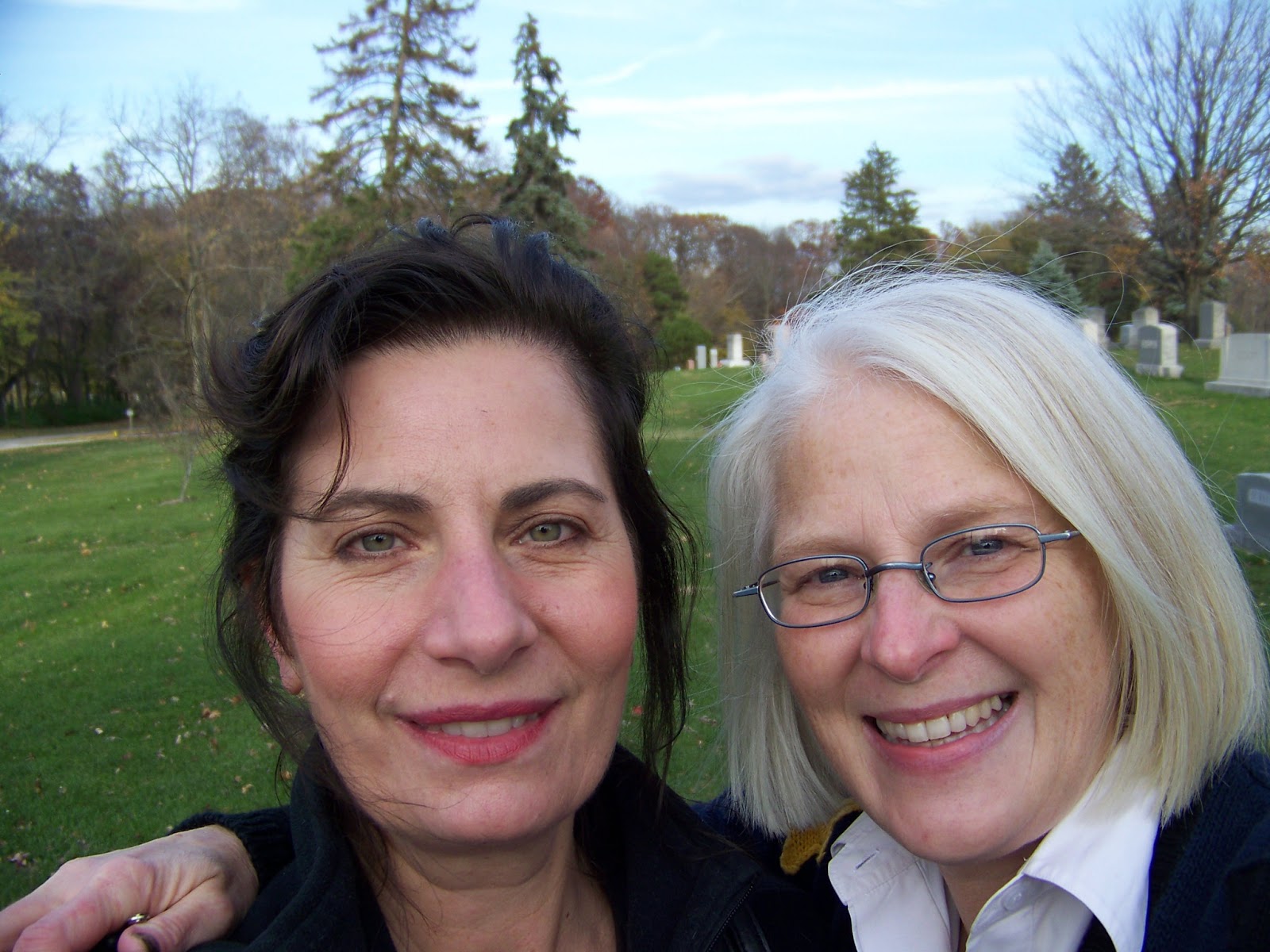
All Souls Day at the Cemetery in West Lafayette
My friend Beata and I found this wayward arrangement,
apparently from the previous Easter,
blown into a bank of dry autumn leaves and rubble.

Beata & Kitti ~ 2 November 2012


I Have Confidence

What will this day be like? I wonder.
What will my future be? I wonder.
It could be so exciting to be out in the world, to be free
My heart should be wildly rejoicing
Oh, what's the matter with me?

I've always longed for adventure
To do the things I've never dared
And here I'm facing adventure
Then why am I so scared

A captain with seven children
What's so fearsome about that?

Oh, I must stop these doubts, all these worries
If I don't I just know I'll turn back
I must dream of the things I am seeking
I am seeking the courage I lack

The courage to serve them with reliance
Face my mistakes without defiance
Show them I'm worthy
And while I show them
I'll show me

So, let them bring on all their problems
I'll do better than my best
I have confidence they'll put me to the test
But I'll make them see I have confidence in me

Somehow I will impress them
I will be firm but kind
And all those children (Heaven bless them!)
They will look up to me
And mind me

With each step I am more certain
Everything will turn out fine
I have confidence the world can all be mine
They'll have to agree I have confidence in me

I have confidence in sunshine
I have confidence in rain
I have confidence that spring will come again
Besides which you see I have confidence in me

Strength doesn't lie in numbers
Strength doesn't lie in wealth
Strength lies in nights of peaceful slumbers
When you wake up -- Wake Up!

All I trust I leave my heart to
All I trust becomes my own
I have confidence in confidence alone


(Oh help!)

I have confidence in confidence alone
Besides which you see I have confidence in me!


sung by the character Maria
in The Sound of Music
by Rodgers and Hammerstein

*****************

Next Fortnightly Post
Tuesday, March 28th

Between now and then, read
THE QUOTIDIAN KIT
my shorter, almost daily blog posts
www.dailykitticarriker.blogspot.com

Looking for a good book? Try
KITTI'S LIST
my running list of recent reading
www.kittislist.blogsppot.com


As the samaras dried out:
Still Life with Book

Saturday, July 28, 2018

Advancing & Receding

VIBRANT HORIZON, ACCUSTOMED, CEREMONIOUS
Red Sky ~ or ~ Red Sea?
Advancing ~ or ~ Receding?

Painting by Leonard Orr

An literary exploration of the intriguing concept
of a perpetual redistribution of human emotion:


"We seem to have learned of the horizon
the art of perpetual retreating and reference."

~ Ralph Waldo Emerson ~
from "Experience" ~ 1844

"It was the tragic part of happiness;
one's right was always made of
the wrong of some one else
."

~ Henry James ~
Portrait of a Lady (Chapter 35, 357) ~ 1888


"The tears of the world are a constant quantity.
For each one who begins to weep
somewhere else another stops.
The same is true of the laugh."

~ Samuel Beckett ~
from Waiting for Godot ~ 1953
See also:
Seen Through Tears & To Cry Or Not To Cry

"Every moment of one's existence
one is growing into more or retreating into less.
One is always living a little more or dying a little bit."

~ Norman Mailer ~
from Advertisements for Myself ~ 1959

"As in the fusion with Mercer, everyone ascended together or, when the cycle had come to an end, fell together into the trough of the tomb world. Oddly, it resembled a sort of biological insurance, but double-edged. As long as some creature experienced joy, then the condition for all other creatures included a fragment of joy. However, if any living being suffered, then for all the rest the shadow could not be entirely cast off. A herd animal such as man would acquire a higher survival factor through this..."
~ Philip K. Dick ~
from Do Androids Dream of Electric Sheep? ~ 1968

"So how do we seize the past? As it recedes, does it come into focus? Some think so. We know more, we discover extra documents, we use infra - red light to pierce erasures in the correspondence, and we are free of contemporary prejudice; so we understand better. Is that it? I wonder. . . .

“The past is a distant, receding coastline, and we are all in the same boat. Along the stern rail there is a line of telescopes; each brings the shore into focus at a given distance. If the boat is becalmed, one of the telescopes will be in continual use; it will seem to tell the whole, the unchanging truth. But this is an illusion; and as the boat sets off again, we return to our normal activity: scurrying from one telescope to another, seeing the sharpness fade in one, waiting for the blur to clear in another. And when the blur does clear, we imagine that we have made it do so all by ourselves.

"Does the world progress? Or does it merely shuttle back and forth like a ferry?"
(100, 101, 105)
~ Julian Barnes ~
Flaubert's Parrot ~ 1984


"Their happiness is not her unhappiness. Unless it is.
What if there is only an equal ratio of happiness to
unhappiness in the world at any given time?"

~ Gabrielle Zevin ~
The Storied Life of A. J. Fikry ~ 2014


"But life is not a zero - sum game.
There isn't a limited quantity of success or happiness,
meaning that if one person achieves something,
the rest of us take an automatic step backward."

~ Natalie Hanes ~ "Introduction" ~ 2015
to Extracts from The Second Sex
by Simone de Beauvoir ~ 1949

“It is because the human spirit knows, deep down, that all lives intersect. That death doesn't just take someone, it misses someone else, and in the small distance between being taken and being missed, lives are changed.

"You say you should have died instead of me. But during my time on earth, people died instead of me, too. It happens every day. When lightning strikes a minute after you are gone, or an airplane crashes that you might have been on. When your colleague falls ill and you do not. We think such things are random. But there is a balance to it all. One withers, another grows. Birth and death are part of a whole.
” (48 - 49)
~ Mitch Albom ~
from The Five People You Meet in Heaven ~ 2003


"It's the universe showing us that we're all connected
and feel the love, happiness, and pain oif one another
-- we just have to be ready to listen."

~ Peggy Carriker Rosenbluth ~ 2014


"One fire burns out another's burning.
One pain is lessened by another's anguish.
Tut man, one fire burns out another’s burning.
One pain is lessened by another’s anguish.
Turn giddy, and be helped by backward turning.
One desperate grief cures with another’s languish.
Take thou some new infection to thy eye,
And the rank poison of the old will die."

~ Shakespeare ~
Romeo & Juliet ~ 1597
Quoted by Peter Abernathy in Westworld ~ 2016


Green Bird ~ and / or ~ Green Fish?
Sky ~ and / or ~ Sea?

Painting by Leonard Orr

*******************

Thanks Len for multiple appearances on my blogs!
Previously Posted Paintings & Poetry:

Fortnightly
Capturing the Ginkgo Light
Like An Ant
I Will Show You Modernism In A Handful of Dust
The Ides of Whatever
Advancing & Receding
2020 ~ The Essential Sincerity of Falsehood

Quotidian
End of Summer Sounds
Golden Paintings by Leonard Orr
Excellent Images
Happy Birthday Dylan Thomas
The same war continues . . .
The Magpie Waiting for his Beautiful Partner
An Ant and a Grain of Sand
Bursting Into Light
Sun ~ Flower ~ Moon
Days of Optimism
Life Without Poetry
What To Do
Star - Spanlged But Unsingable
That Lost Time & Place

Book List
Lovely As A Tree
Evening ~ Timing ~ Floating: Poetry by Leonard Orr

Poems: "Past Tense, Future Tense" ~ "Yiddish for Travellers"
"The Loop" ~ "Desperate Times" ~ "Optimist" ~
"Sun and Wheatfields" & "Russian Olives" ~ "Monet's The Magpie"

SEE YOU IN TWO WEEKS ON MY
Next Fortnightly Post
Tuesday, August 14th

Between now and then, read
THE QUOTIDIAN KIT ~ Pie Safe
my shorter, almost daily blog posts
www.dailykitticarriker.blogspot.com

Looking for a good book? Try
KITTI'S LIST
my running list of recent reading
www.kittislist.blogspot.com

Wednesday, March 15, 2017

The Ides of Whatever

A TIME WHERE ALL'S ACCUSTOMED, CEREMONIOUS
Posting a day late in honor of the time - honored
historic and historical Ides of March.


I came across this mysteriously annotated sugar packet when cleaning out my backpack the other day. How can I explain it? I searched my mind but drew a blank. It seems that once again I've written a note to myself yet completely forgotten what it was that I intended to remember. I can only assume that at some point in my travels, a stray thought crossed my mind -- something about "The Present" -- and, having a pen in hand but no paper, I jotted down a note to myself on the nearest portable surface -- thank goodness for the ubiquity of sugar packets!

It wouldn't be the first time! A friend of mine at Notre Dame asked me once how I could write down so little, and I assured her that I would retain what I needed to know. She couldn't believe that sometimes I didn't even have a notebook, and she liked to say that if I suddenly needed to write something down, I would just reach back and tear the label from my tee - shirt and jot down a word or two for future reference. I never really did that, but I liked that story!

Alas, despite my best intentions, I am unable to interpret the sugar packet message, sent by my very own self from the past into the future, never to be understood in the present. I am not alone, however; Joan Didion's journal entry -- "dinner with E, depressed" -- suffers the same indecipherable fate:

Who is E?
Was this "E" depressed,
or was I depressed?

Maybe one day my sugar packet message will reveal itself to me. Was I thinking of a gift for someone -- a present to purchase, wrap, send, or bring to a party? Was it perhaps a self - actualizing reminder to stay focused on the time at hand, to live in the present moment. One thing I know for sure, I will never solve this riddle by staring at the sugar packet, so I think it is about time to move on to some prose and poetry about time.

"Lets look to the past only as it gives us pleasure.
And look to the future only as it gives us hope."

from Death Comes to Pemberley (2011)
by P. D. James (1920 - 2014)

Jane Austen version:
"Think only of the past as its
remembrance gives you pleasure."

So often we are impatient for time to pass. Years ago, in a book from childhood, I read a story that warned against such impatience. I have lost all the details -- title, author, plot; yet one scene has stayed with me, though I can no longer recall the names of the characters: the grandchildren are piled into a one - horse open sleigh, riding over the river and through the wood with their grandfather. Excited for their destination, they start wishing they were already there, but the grandfather warns: "You must never wish the time away!" How often that line has come back to me!

Even so, we sometimes wish for the time to fly. The Here and Now can drive us a little crazy -- making us tense, so to speak! It might be that you are not really into the Ides of March, or the Ides of He Who Must Not Be Named, or the Ides of Whatever. Maybe March just isn't your favorite month, as was certainly the case for one of my favorite Philadelphia columnists Karen Heller (now of the Washington Post). In her humorous essay "Nine days to go," she gloomily describes the final days of February:
You must not fight February but embrace it like the cold, wet, aging testy, mangy, drooling gray mutt that it is. February is here to make us appreciate May . . . How can you love May when you haven't Februaryed in grand style? And so we wallow and we wait knowing that only this month could deliver a comeback, a punchline, a headache as nasty and wicked and ugly as February.
March.
~ from the Philadelphia Inquirer, mid 1990s
Poet Leonard Orr shares the negative sentiment, suggesting "daychotomies" or "weekectomies" to get through the offending times, going so far as to eliminate entirely The Month That Must Not Be Named. Even the title offers some alternatives to the Present Tense:
Past Tense, Future Tense
My naive calendar has so much sadness now
I could not stand it. Little did I know,
little did I know. I snipped away the foul days.
I completely excised whatever was that
month after February, its name I will not mention.
If it comes up accidentally, I drown it out
with whirling greigers and stamping feet.
April
turned out far better, though individual days
when we could not be together, these I carefully
snipped away, performing daychotomies,
weekectomies, and sutured the ragged sad edges
together, wetting the wounds as needed
with my abundant fluids, all my excess. I expanded
those few times we were together, those dates
receiving hour - augmentations; I botoxed my tongue,
the tips of my fingers, to seal inside me those
recollections of you, the spectacular aerie,
the tiny bits of time, ticking, always ticking.
May and the first days of June, little did I know,
little did I know, so wonderful and blissful,
joyful in my last days, my running out of sand,
and now these blanks of time, soggy, unprinted
months with no days, no light, no passionate glowing.

(emphasis added)
~ Leonard Orr ~
from his collection Why We Have Evening

P.S.
Political Post Script for
The Ides of Trump

My postcard messasges:
1. Stop Gerrymandering
2. Protect Planned Parenthood & Roe v. Wade
3. Don't Build the Wall
4. Remember the traditional motto of our country:
E Pluribus Unum
5. Honor the Statue of Liberty:
"Give me your tired your poor . . . the homeless . . .
I lift my lamp beside the golden door."

SEE YOU IN TWO WEEKS ON MY
Next Fortnightly Post
Tuesday, March 28th

Between now and then, read
THE QUOTIDIAN KIT
my shorter, almost daily blog posts
www.dailykitticarriker.blogspot.com

Looking for a good book? Try
KITTI'S LIST
my running list of recent reading
www.kittislist.blogspot.com

Tuesday, February 28, 2017

Work, Play, Wordplay

AN OCEAN WHERE ALL'S ACCUSTOMED, CEREMONIOUS
As Far As the I Can Sea

For cruise reading earlier this month, I took along Lolita, which has been on my "to read" list for 40 years or so. After the first few pages of Humbert Humbert's clever alliterative word sequences, I thought back to the time when I set out to write a paper about Work, Play, and Wordplay in the short story "Araby." I never tire of re - reading this story of illusion and disillusion:
"The cold air stung us and we played till our bodies glowed. Our shouts echoed in the silent street. The career of our play brought us through the dark muddy lanes behind the houses, where we ran the gauntlet of the rough tribes from the cottages, to the back doors of the dark dripping gardens . . .

"I answered few questions in class. I watched my master's face pass from amiability to sternness; he hoped I was not beginning to idle. I could not call my wandering thoughts together. I had hardly any patience with the serious work of life which, now that it stood between me and my desire, seemed to me child's play, ugly monotonous child's play. . . .

"My uncle said he was very sorry he had forgotten. He said he believed in the old saying: 'All work and no play makes Jack a dull boy.' "

James Joyce ~"Araby" ~ Dubliners ~ 1914
"The career of our play" -- there is just something so pleasing about that phrase and the use of "career" to mean a crazy path -- not a life - work trajectory. Even though I know that Joyce meant play, I still thought of work -- as does the boy's uncle. After all, the narrator of "Araby" is a very serious boy, earnest and task - oriented, who merges work and play. He is not looking for fun at the bazaar, he is on a quest.

Likewise, I know the boys in the story were rushing headlong around the neighborhood -- careering. But perhaps they were also tilting and veering -- careening. Work Play Career Careen. How enmeshed are these linguistic connections? Word Detective explains the etymology:
Although “careen” and “career” as verbs are often used interchangeably today, they are, in fact, quite separate words. Strictly speaking, “careen” [Latin root = “carina" = “keel of a ship”] means “to lean over, to tilt,” while “career” [Latin root = “carrus” = “wheeled vehicle”] as a verb means “to rush at full speed” (with implications of recklessness). . . .

“Career” as a verb meaning “to move at full speed” is actually the same word as the noun “career” meaning “profession or course of employment or activity.” . . .

Interestingly, “careen” and “career” began to be used interchangeably only in the early 20th century, just about the time people noticed that a motor car rounding a curve at high speed (“careering”) tended to tilt quite a bit (“careening”). Purists still draw a distinction between the two words, but it’s really a losing battle at this point.
At long last I realize what would have saved the day for my rejected paper proposal -- having read Lolita 35 years ago instead of waiting until now! If only I had done so, I could have bolstered my argument with numerous examples from Nabokov, the Master of Wordplay! Some of my favorites:
43: "Monsieur Poe - poe," as that boy . . . called the poet - poet

43, 81: a swim in Our Glass Lake . . . Hourglass Lake -- not as I had thought it was spelled

50: she denies those amusing rumors, rumor, roomer

53: Haze, Dolores . . . dolorous and hazy

54: creeping . . . crippling

57, 60: Humbert the Hummer . . . Humbert the Hound

60: Carmen - barmen . . . barmen, alarmin', my charmin', my carmen, ahmen, ahhamen . . .

70: the dreadful, mysterious, insidious words "trauma," "traumatic event," and "transom"

71: I might blackmail -- no, that is too strong a word -- mauvemail

77: ecru and ocher and putty - buff - snuff

92: Campus, Canada, Candid Camera, Candy . . . Canoeing or Canvasback

112: Anyway, something abdominal. Abominable? No, adominal.

114: "Ensuite?" . . . "Ansooit . . . "

118: not Humberg and not Humbug, but Herbert, I mean Humbert . . .
118: "I think it went to the Swoons," said Swine . . .
Unfortunately, as with Catcher in the Rye, I came late to Lolita. Otherwise, I might have used Nabokov's examples of connective wordplay to substantiate my own: work play career careen. Or as Humbert Humbert himself might have elaborated: Career Careen Cartoon Cardoon.

Not forgetting Bill Bryson's travel suggestion to "carom about the country in any pattern you wished"! Or William Kent Krueger writing that the "July brilliance caromed off the floor and smacked the wall" (Ordinary Grace, 237). And similarly from A Gentleman in Moscow: "He also had a whole host of entertaining alternatives to the phrase enable and ensure, ranging from bustle and trundle to carom and careen" (69 - 70, emphasis added).

If one well - placed word brings to mind another, follow the connection and see what happens! Who knows what truth may be revealed by the time you reach then end of the chain? Never mind the naysayers and killjoys; no vocabulary connection is without merit.

After reading Lolita at sea, it is now time to re - read Reading Lolita in Tehran. No doubt, thanks to my new, improved understanding of Nabokov, many previously missed connections will fall into place. Coincidences are always there for the taking. Connections are always there for the making.

". . . to the Bermudas or the Bahamas or the Blazes."
(Lolita, 36)

Wordplay from previous / future posts . . .

Len Lent Lentils

Cat, Bat, Batman, Batuman, Batground

Annecharico, Carrigan Carrillo, Carriker, O'Kereke

Carnage, Carnival ~ Strangled, Estranged

********************

Cerebral Typos . . .
When I meant THOUGH, I added a final "T" and typed THOUGHT.
When I meant THIN, I added a final "K" and typed THINK.

********************

Gerry's Cruise Reading:
Every Man Dies Alone by Hans Fallada

SEE YOU IN TWO WEEKS ON MY
Next Fortnightly Post
Wednesday, March 15th ~ "Beware the Ides of March!"

Between now and then, read
THE QUOTIDIAN KIT
my shorter, almost daily blog posts
www.dailykitticarriker.blogspot.com

Looking for a good book? Try
KITTI'S LIST ~ "Short Books for a Short Month"
my running list of recent reading
www.kittislist.blogspot.com

Monday, December 28, 2009

Fast Away The Old Year Passes

A HOUSE WHERE ALL'S ACCUSTOMED, CEREMONIOUS
A CHILD'S CHRISTMAS IN INDIANA

"And now let us welcome the new year,
full of things that have never been."
--Rainer Maria Rilke


Why is it that the world seems to spin a bit faster with every passing year? At midnight on Halloween, I crossed my fingers in hopes of some magic that would make the calendar still say "October" when I turned the page over. The golden days had flown by so quickly, I could have used another go at the entire month! But, no, November it was! And no sooner had the rush toward Thanksgiving begun than we had overtaken yet another feast day and finished off another month. Any chance that we could repeat November? None whatsoever. It was December! It was Christmas! It's almost New Year's Eve! Time not only to turn the calendar over, but to hang up a brand new one.

One great thing about our neighborhood (probably yours too) is the talent that our neighbors have for keeping up with the rapid succession of holidays, no matter how quickly each arrives and departs. What a seasonal thrill it was to drive down the block the day after Halloween and spy the houses already illuminated for Christmas -- houses which only hours before had been festooned with spider webs and scarecrows! By Thanksgiving, it was possible to take the family on an evening drive and admire the winter wonderland of wreaths and trees and reindeer that our celebratory neighbors had devised for our viewing pleasure.

You can't say we weren't ready! Does anyone really wish that the decorations went up later and came down sooner? I certainly don't! In fact, I like to make a game of predicting which lights will last the longest . . . and with so many possible conclusions to the season, it's anybody's guess: The Twelfth Day of Christmas, Martin Luther King Day, Ground Hog Day, Valentine's Day, The Ides of March. Can anyone hold out until Palm Sunday?

January is a time of new beginnings, promising many more holidays to come, but like the slowly fading decorations on our front doors, it contains a lingering echo of the month and year just past. It's good to remember that this month is named after the old two - headed, two - faced Roman god, Janus, who possessed knowledge of the future and wisdom of the past. Conveniently, he could see forward into the New Year and backward into the Old. It was customary to place his image, maybe a small statue or amulet, at the front entrance of every home where he could look outward at the passersby as well as inward toward the home dwellers.

So, indulge in a few contemplative hours this month, gazing forward and glancing back. When you take that wreath down and put those cards away, think of the words of Malcolm S. Forbes, think of your friends, think of your neighbors:

"I hate these days immediately following the holidays. Emptying the house of Christmas trees, decorations and children is like emptying a home of warmth. But at least there’s the pile of Christmas cards to be looked through again before you do whatever you do when done with them. They serve as a cheerful handshake during the uncheerful letdown after Christmas. Don't stop sending them. Christmas cards are worth all the bother. In fact, the bother’s a good part of the pleasure."
--Malcolm S. Forbes (1967)
Christmas Cards In My Kitchen

P.S. HAPPY NEW YEAR!
Next post will be on Thursday, January 14th, 2010!
Between now and then, be sure to read
my shorter, almost daily blog posts on
THE QUOTIDIAN KIT
www.dailykitticarriker.blogspot.com

(British Holiday Recipes:
Christmas Cake,
Figgy Pudding,
Mince Pies;
& More!)